
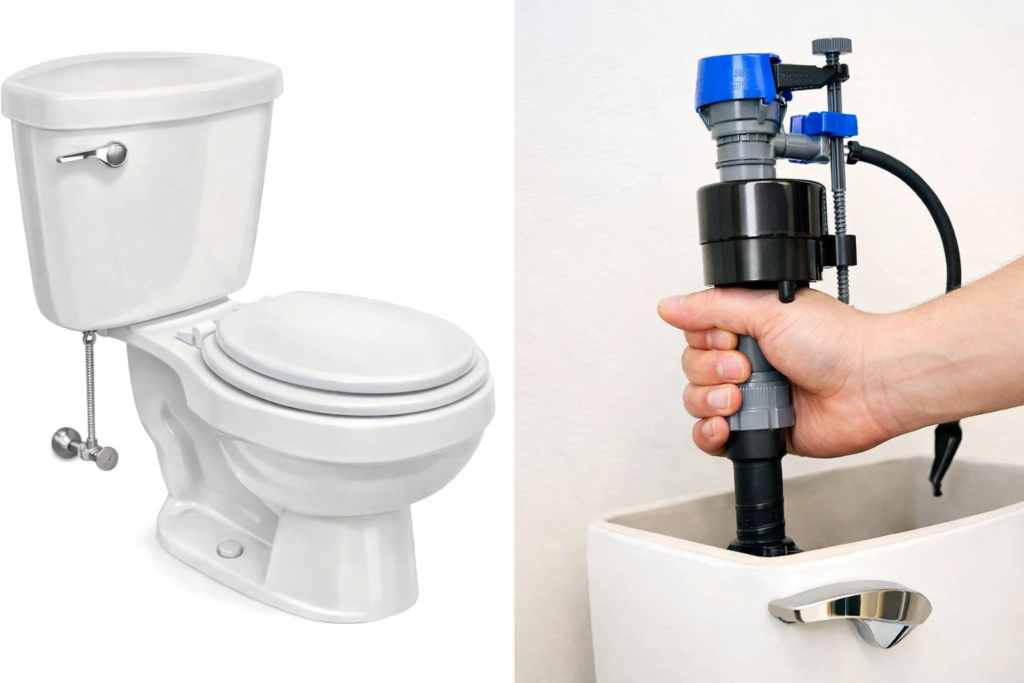
The fill valve is one of the most important parts inside a toilet cistern. Its job is simple: after the toilet is flushed, the fill valve allows fresh water to refill the cistern so it’s ready for the next flush.
Although it’s a small component, when a fill valve starts to wear out it can cause several common toilet problems, including slow filling, constant running water, or noisy cisterns.
Understanding how fill valves work can make it easier to recognise when something isn’t working properly.
What Is a Toilet Fill Valve?
The fill valve is the mechanism inside the cistern that controls the incoming water supply.
When the toilet is flushed, the water level inside the cistern drops. This triggers the fill valve to open and allow fresh water to flow in from the mains supply.
As the cistern fills back up, a float attached to the valve rises with the water level. Once the correct level is reached, the valve shuts off automatically.
This simple process happens every time the toilet is flushed.
The Main Parts of a Fill Valve
Most modern fill valves contain several small components working together.
Typical parts include:
- Float mechanism – rises and falls with the water level
- Valve body – the main housing that connects to the water supply
- Inlet connection – where the water pipe feeds into the valve
- Shut-off seal or diaphragm – controls when the water stops flowing
- Refill tube – directs a small amount of water into the overflow or pan to maintain the correct level in the bowl
Although designs vary between manufacturers, the basic principle remains the same.
Types of Toilet Fill Valves
Over the years, several different types of fill valves have been used in toilets.
Traditional Ball Float Valves
Older toilets often used a large plastic or copper ball attached to a long arm.
As the water level rises, the ball float lifts the arm and gradually closes the valve.
You’ll still find these in some older cisterns, but they are less common in modern toilets.
Modern Compact Fill Valves
Most modern toilets use a compact vertical fill valve.
Instead of a long arm and ball float, these valves have an internal float that moves up and down inside the valve body.
They take up less space inside the cistern and are generally easier to replace.
Common Fill Valve Problems
Because fill valves operate every time the toilet is flushed, they eventually wear out.
Some common signs of a faulty fill valve include:
- Toilet taking a long time to refill
- Cistern making loud or vibrating noises while filling
- Water continuing to run after the cistern is full
- Low water level inside the cistern
- Overflow pipe constantly trickling water into the bowl
Many of these issues happen when the internal seals or diaphragms inside the valve begin to deteriorate.
Why Fill Valves Wear Out
Several factors can shorten the life of a fill valve.
Common causes include:
- Hard water and limescale buildup
- Debris in the water supply
- General wear from regular use
- Older plastic components becoming brittle over time
Even a small amount of debris inside the valve can stop it from shutting off properly.
Can Fill Valves Be Repaired?
In some cases, a fill valve can be cleaned or adjusted to restore normal operation.
However, many modern fill valves are designed as replaceable units, meaning the simplest solution is often to fit a new valve.
Replacing a worn fill valve usually restores proper water levels, quiet operation, and normal refill speed.
Summary
The fill valve is the component inside a toilet cistern that controls how the tank refills after a flush. It works by opening when the water level drops and automatically shutting off once the correct level is reached.
Over time, fill valves can wear out or become blocked with debris, leading to common problems such as slow filling, noisy cisterns, or toilets that constantly run.
Fortunately, most fill valve issues can be resolved by replacing the faulty valve, restoring the toilet to normal operation.